

1. TL;DR
As 2026 approaches, family offices are navigating a landscape defined by structural shifts rather than short-lived trends. AI has become embedded infrastructure, generational transition is reshaping the purpose of wealth, and geopolitical fragmentation has made uncertainty the operating baseline. Across this, a renewed focus on humanity, identity, and long-term resilience is shaping how families prepare for the decade ahead.
Reclaiming Humanity in an AI World:
AI is accelerating, but human discernment, judgment, and connection are regaining strategic value. Families are shifting toward wellbeing, regenerative wealth, principled curation, and continuous reskilling as AI-era work reshapes capability needs.
Strategic Posture & Resilience:
Uncertainty is the new baseline. Long-termism, foresight, and optionality are emerging as core disciplines as families build buffers, strengthen adaptive governance, and position for structural geopolitical and market volatility.
Evolving Operations & Impact:
Identity-driven leadership is rising as families anchor decisions in values, clarity, and long-term purpose. Modernised operations, technology-enabled workflows, and mission-aligned impact are reshaping how family offices govern, allocate, and steward capital.
2. Introduction
Each year, we look back at the signals and shifts that shaped the family-office landscape and look ahead to the themes we believe will define the next chapter. Over the past year, we again observed that we’re living through a period of significant reordering in the world to which family offices are adapting. Many of the forces shaping families today are multi-year shifts that continue to deepen, driven by ongoing advances in AI, generational transition, new global dynamics, and a renewed focus on human wellbeing.
In 2025, change accelerated within family offices, which gave rise to a new leadership model rooted in responsible technology adoption and forward-looking agility.
As we look ahead, many of the themes spotlighted for 2026 involve currents requiring ongoing attention: an insistence on human judgment in an AI-saturated world, long-termism in a short-term environment, the professionalisation of foresight, and the shift from optimisation to optionality. Together, families are re-prioritising meaning, identity, and purpose as their strategic anchors in a dynamic environment.
This report shares an overview of what we’ve observed, where we’re at, and where we could be heading, with observations, data points, and practical implications for family offices navigating an increasingly complex world.
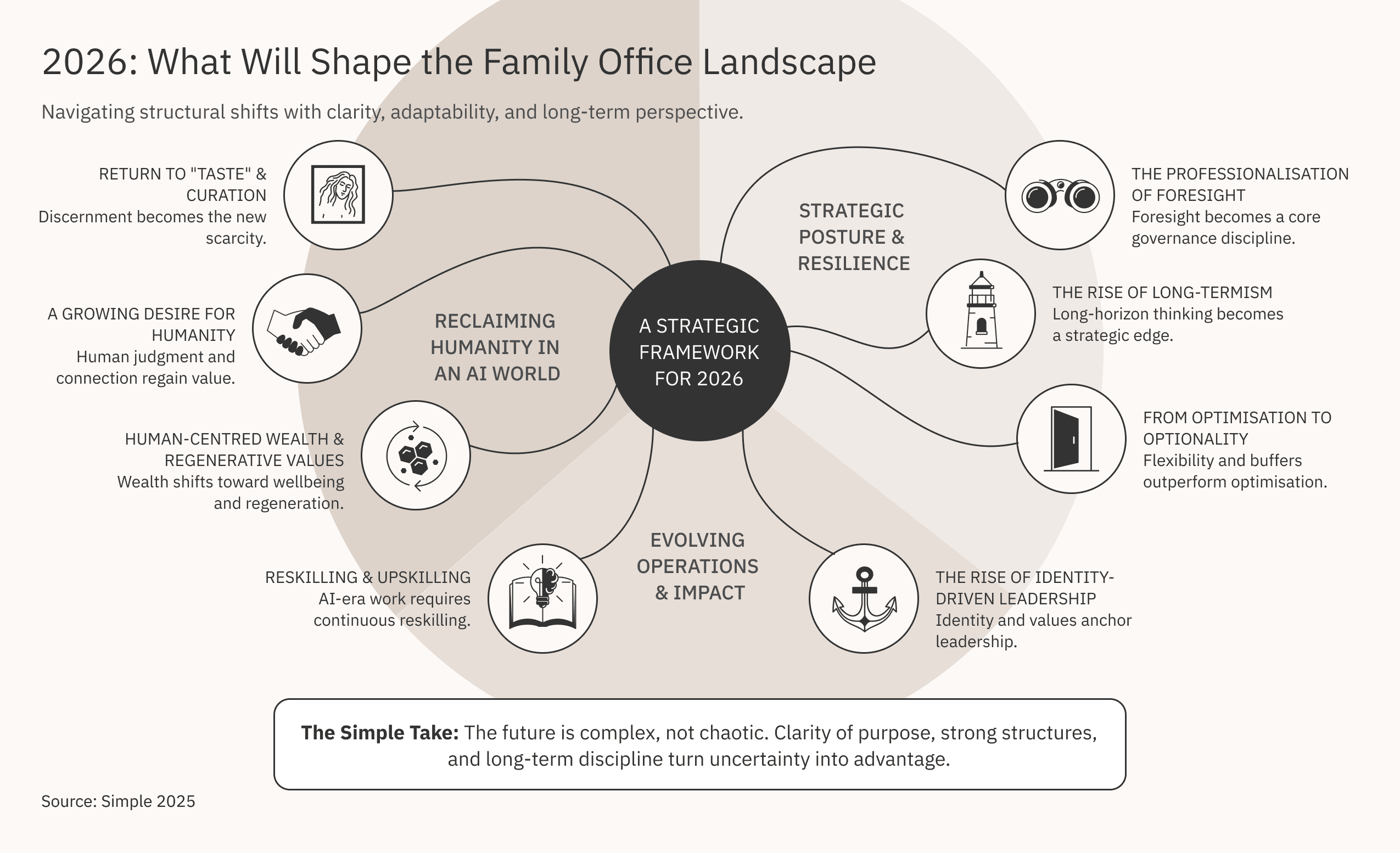 Click the image to view the full-resolution framework.

3. Looking back at the last year
Looking back at 2025, most of the themes we covered played out with unexpected speed and, in some cases, far greater structural impact than anticipated.

1. AI moved from experimentation to core family office infrastructure
We expected AI to mature, but the pace surprised even the most optimistic observers. Across the industry, AI development sped up and became part of the everyday operating fabric: powering document extraction, portfolio analytics, reporting workflows, and internal knowledge systems. Many tech firms (large and small) brought features directly into reconciliation, data validation, and client reporting, embedding this technology in family office workflows.
This also fuelled a broader convergence across private banking, wealth management, and technology. Large institutions have renewed their attention to platforms that can unify data, advice, and service models. Several regional banks and global players expanded through acquisitions designed specifically to strengthen AI capabilities and build digital infrastructure. In parallel, specialist “Vertical AI Agents” continued to grow in legal, due diligence, and investment screening, augmenting work previously done by consultants and analysts.
2. Wellness and longevity became core strategic priorities
We anticipated that health and well-being would grow in importance — and they quickly became central pillars of strategy. Longevity tech attracted sustained deal flow, with families allocating to preventive diagnostics, personalised medicine, and cellular health companies. Wearables like Oura and Whoop continued their mainstream adoption, making biomarkers part of everyday decision-making for executives and investors.
Inside organisations, burnout and cognitive overload grew from private frustrations to governance-level concerns. Many firms also sought out new wellbeing frameworks, more sustainable work rhythms, and clarity of expectations.
3. Geopolitical fragmentation intensified, making uncertainty the baseline
We expected increased geopolitical volatility and instability to become the default condition. The US thrust tariffs into the role of a geopolitical dealmaking tool and injected significant instability into global trade. Firms in Europe and other traditional allies did not escape, and made long-term strategic planning difficult.
While some firms continued post-COVID-19 nearshoring by reorganising their supply chains away from China toward India, Vietnam, and Mexico, this often proved to be a difficult objective for practical reasons and not a shield from US tariff policy. India and the UAE attracted record levels of foreign investment. The Russian invasion of Ukraine and expanding hybrid war, combined with still broader conflict in the Middle East to keep energy markets unstable and disrupt shipping routes through the Red Sea.
Families responded by reworking portfolios around resilience: regional diversification, hard assets, infrastructure, private credit, and mission-critical categories.

4. Generational transition reshaped the purpose and practice of wealth
The wealth transfer continued, and its effects became more visible. Next-gen leaders stepped into governance roles, pushed for digital transparency, and demanded real-time reporting, collaboration tools, and more intentional communication from advisors.
Values-driven investing gained momentum, although many younger wealth holders also paused new ESG allocations while seeking newer frameworks to align with their values, backed by clearer data.
Succession challenges also intensified in the private wealth sector. Thousands of advisors approached retirement age, prompting consolidation and new partnership models to meet the expectations of younger clients.
5. Sustainable investing matured beyond ESG toward measurable, tech-enabled impact
Sustainable investing entered a new phase. Biodiversity credits gained early traction; blended-finance structures re-emerged as practical tools for large-scale climate and nature projects; and asset managers softened their ESG language while increasing their focus on underlying climate and impact strategies.
Technology played a much larger role than expected in measuring impact. Satellite verification, AI-powered climate models, and new measurement systems offered new ways to track environmental and social outcomes with increased granularity and responsiveness. Families increasingly moved toward nature-positive, data-backed, and future-focused investments.

A shift we did not expect: the rise of a new leadership model
While we anticipated many structural shifts, one development became especially defining: the emergence of a new leadership archetype across the family-office world.
The shifting global order, information and data firehoses, and new computational tools placed extreme demands on leaders to navigate unprecedented cognitive, emotional, and operational complexity. This elevated a new set of capabilities:
- Leading Yourself: building resilience, clarity, and sustainable routines for personal sustainability.
- Leading Others: creating psychological safety while maintaining disciplined autonomy within teams.
- Leading Technology: making responsible decisions about AI adoption and governance.
- Leading Ideas: filtering noise and focusing on long-term strategy and agility.
- Leading Change: operating with continuous adaptation rather than one-off transformations.
This leadership evolution may prove to be one of the most important long-term shifts in the sector — shaping how family offices govern, allocate, build teams, and steward their legacy.

4. Looking ahead
Many of the signals shaping the year ahead are not new. Several are multi-year structural shifts that continue to evolve, accelerated by AI, generational change, and shifting global dynamics. They span changes within families, family offices, and global restructuring.
Below, we highlight the eight themes we believe will shape 2026, each supported by observable data and industry developments, translated into their relevance for family offices.
1. A return to “taste” and curation
Long operating forces on social media sites have led to their enshittification. Now, AI media production is extending this downward spiral throughout all media spheres. To wit, AI-generated content increased exponentially in 2025, with estimates suggesting over 60% of online content will be AI-generated by 2026 (Gartner projection published in 2024).
This is already creating a pushback that businesses are moving to capture. Consumer brands are reporting a shift toward handcrafted, limited-run, and human-made products as a reaction to mass AI production. Creative industries such as design, fashion, and publishing are now hiring “taste editors” and human curators to differentiate from algorithmic sameness.
In a world of the overproduction of poor-quality content, taste becomes the new scarcity. The ability to choose, curate, and craft meaning will define the most sophisticated investors, brands, and leaders.
For family offices:
The time, resources, and knowledge to discern indicate excellence in oversaturated media and information environments. For families, this influences how they are educating the next-gen around judgment and meaning-making. They are renewing and refining their approach to their branding and reputation strategy. Many are renewing their commitment to taking a holistic approach to align all their activities, inclusive of investing, community contributions, and operations around enduring themes.
The families that curate—not just consume—will set the cultural tone for the next decade.

2. A growing desire for humanity in everything
Global surveys (McKinsey, Gallup 2024) show rising demand for human connection, authenticity, and in-person experiences after years of digital saturation. This is leading to clear market shifts to capture this form of engagement. Hospitality, wellness, and craft industries saw double-digit growth in 2024, driven by “experiential” spending rather than goods, which proved lasting in 2025. Companies offering human-led customer service (as opposed to chatbot-only models) reported higher retention and satisfaction in 2025.
From products to leadership to experiences, people are gravitating toward what feels hand-made, imperfect, embodied, and human: a reaction to AI, automation, and algorithmic sameness.
For family offices:
Families increasingly prefer advisors who deploy leading technology guided by genuine human judgment and experience. Many are continuing their commitment to philanthropic projects rooted in verifiable community impact. Family offices are also centring governance models that emphasise practices grounded in human capacity and relationship building.
Humanity increases in value as a strategic asset guiding how families work, invest, and build cohesion.
3. The emergence of “human-centred wealth” and regenerative values
For years now, the family office ecosystem has been beating the drum of the intergenerational transfer of wealth as both an opportunity and a caution for governance and operations. The ongoing $84 trillion US wealth transfer (Cerulli Associates) is now reshaping priorities within family offices—next-gen heirs consistently rank wellbeing, relationships, and purpose above financial returns. Many view the drive for sustainability as too slow.
Now, regeneration, circularity, and “net positive” design are becoming the expectation that shapes portfolios and partnerships. Over 40% of next-gen wealth holders say that traditional wealth structures feel misaligned with their values (UBS Global Family Office Report 2024). Demand for coaching, family dynamics work, and human performance programs increased across Europe, the UAE, and the US.
For family offices:
Families are rethinking the purpose of wealth. Wellbeing, resilience, intergenerational relationships, legacy, and personal development are becoming as central to in-house operations as they are to portfolio strategy. Families are creating enduring practices that prioritise mental clarity, relational health, intergenerational trust, and the entanglement of personal and professional development.
4. The professionalisation of foresight within family offices
Corporations around the world have been building internal foresight functions for years. In 2024, more than 70% of Fortune 100 companies used structured scenario planning to operationalise their capacity for foresight (Institute for the Future). This trend continued in 2025 with boardrooms requesting horizon scanning, early-warning indicators, and risk dashboards—partly driven by geopolitical volatility.
The proliferation of AI prediction tools has made foresight more accessible, yet they demand human intervention, judgment, and deep knowledge to guide a successful trajectory.
2026 will bring more structured horizon scanning, scenario thinking, and sense-making practices into governance to mitigate risk in a period of shifting geopolitical relations and markets.
For family offices:
FOs face asymmetric risk with their small teams, long horizons, and high complexity. Yet, formal foresight gives families clearer decision pathways, better risk mitigation, and more informed investment governance. Operational excellence demands this approach to tasks such as planning for capital calls or gaming out the cascading effects of scenarios in our complicated age.
For many family offices, 2026 will be the year foresight becomes a core governance discipline to rise to the challenge brought by a changing world.

5. The rise of long-termism in a short-term world
Public markets are increasingly focused on the short-term. The average holding period for equities is now below 10 months, down from 5 years in the 1970s. This quickening marks a significant reorientation of the pace of markets, increases risk, and raises the need for timely decision-making. Political cycles also shortened and grew more volatile in 2024–2025.
At the same time, long-term assets—farmland, infrastructure, private credit, and energy transition investments—outperformed many short-term strategies over the past 24 months. Clearly, these trends increase the premium on long-horizon thinking by those entities with the resources and capacity.
For family offices:
Family offices are ideally positioned to balance their approach to immediate uncertainty with patient long-term strategies. It is time to lean into these core family office strengths by allocating to long-dated assets, building resilient intergenerational structures, focusing on health, land, education, and stable institutions.
Long-termism will become a competitive moat for families to ensure they thrive for generations to come.
6. The shift from optimisation to optionality
In uncertain times, it is crucial to open options and create the agile capacity to pursue them. Corporate strategy has moved away from “lean optimisation” toward redundancy, slack, and optionality—mirroring shifts after COVID-19, supply chain shocks, and AI disruption. These trends can be seen in the choices of the largest investors. Private equity firms are openly adopting option-value frameworks in their investment committees. Sovereign wealth funds are increasing liquidity buffers to remain opportunistic in volatile markets.
For family offices:
Families will increasingly build strategic slack into their systems through capital reserves, diversification across geographies, and flexible investment vehicles to respond faster to emerging opportunities. These operationalised forms of optionality will increase as a strategic advantage.
In uncertainty, families that preserve “room to manoeuvre” will outperform those trying to optimise for a predictable world.

7. Reskilling and upskilling
77% of global employers report difficulty filling key roles (ManpowerGroup Talent Shortage Survey 2024) either internally or through hiring. Yet, AI is automating administrative, analytical, and creative tasks, requiring the widespread reskilling of these impacted workers. Key industries positioned to benefit from recent technological developments, such as major institutions (banks, consulting firms, asset managers), announced large-scale retraining programs in 2024–2025.
We are at the tip of a great reshuffling of the global workforce, requiring investments in adult learning and new workers by businesses and governments to re-tool society’s most valuable resource: people.
For family offices:
Most FOs lag behind large organisations when it comes to skills transformation, even while AI is reshaping their operations even more dramatically. 2026 will require family offices to dedicate resources to rise to the current challenges. Investment in technological and operations training and education for FO teams will accompany attention to optimising new work and decision-making flows. This will include developing clearer expectations for hybrid and tech-enabled work and new performance models.
8. The rise of identity-driven leadership
Leadership development is increasingly rooted in narrative, story, and values. This is evident in top executive-education programs globally and resonates out through private and public, and profit and non-profit entities alike. Family enterprises investing in identity work report higher cohesion and reduced succession conflict. Next-gen groups are actively exploring ancestry, belonging, and meaning as strategic inputs to decision-making.
For family offices:
Families explore their own story, ancestry, and values as guiding strategic anchors so that identity becomes a strategic anchor to clarifying purpose, strengthening their governance processes, shaping their investment philosophy, and maintaining continuity through transitions.
Families that understand who they are make better long-term decisions.

5. The year ahead
As we step into 2026, the landscape facing all organisations, big and small, is defined by the acceleration of many slow shifts. The pace of technological development continues to increase. Generational expectations keep evolving. Global conditions remain complex and uneven. And the definition of wealth itself is expanding beyond capital toward wellbeing, identity, stewardship, and long-term resilience.
The year ahead will not reward rigid plans or purely defensive thinking. Instead, it calls for clarity, adaptability, discernment, and a leadership mindset that blends strategic discipline with human intelligence. Many of the themes outlined in this report—the rise of long-termism, the desire for humanity in an AI-saturated world, the importance of optionality, the professionalisation of foresight, and the renewed focus on identity and purpose—are not one-year trends. They are ongoing forces that will continue to shape families, organisations, and investment decisions well into the next decade.
For family offices, there is an opportunity for strong leaders to step up and embrace these changes by strengthening internal capabilities, building more resilient and values-aligned portfolios, developing leadership that can navigate ambiguity with steadiness, and creating environments where all generations feel both empowered and anchored.
The future will remain complex, but complexity does not need to be chaotic. With the right structures, clarity of purpose, and a long-term orientation, families can turn uncertainty into advantage and continue to build meaningful, multi-generational impact. Until next year.
6. Acknowledgements
We would like to thank the family offices and experts who contributed insights to this outlook. Their perspectives helped shape a clearer understanding of the structural shifts influencing 2026. A special thank you to Nicolás Arroyo, whose thinking on foresight, identity, and long-term design meaningfully informed this work.


